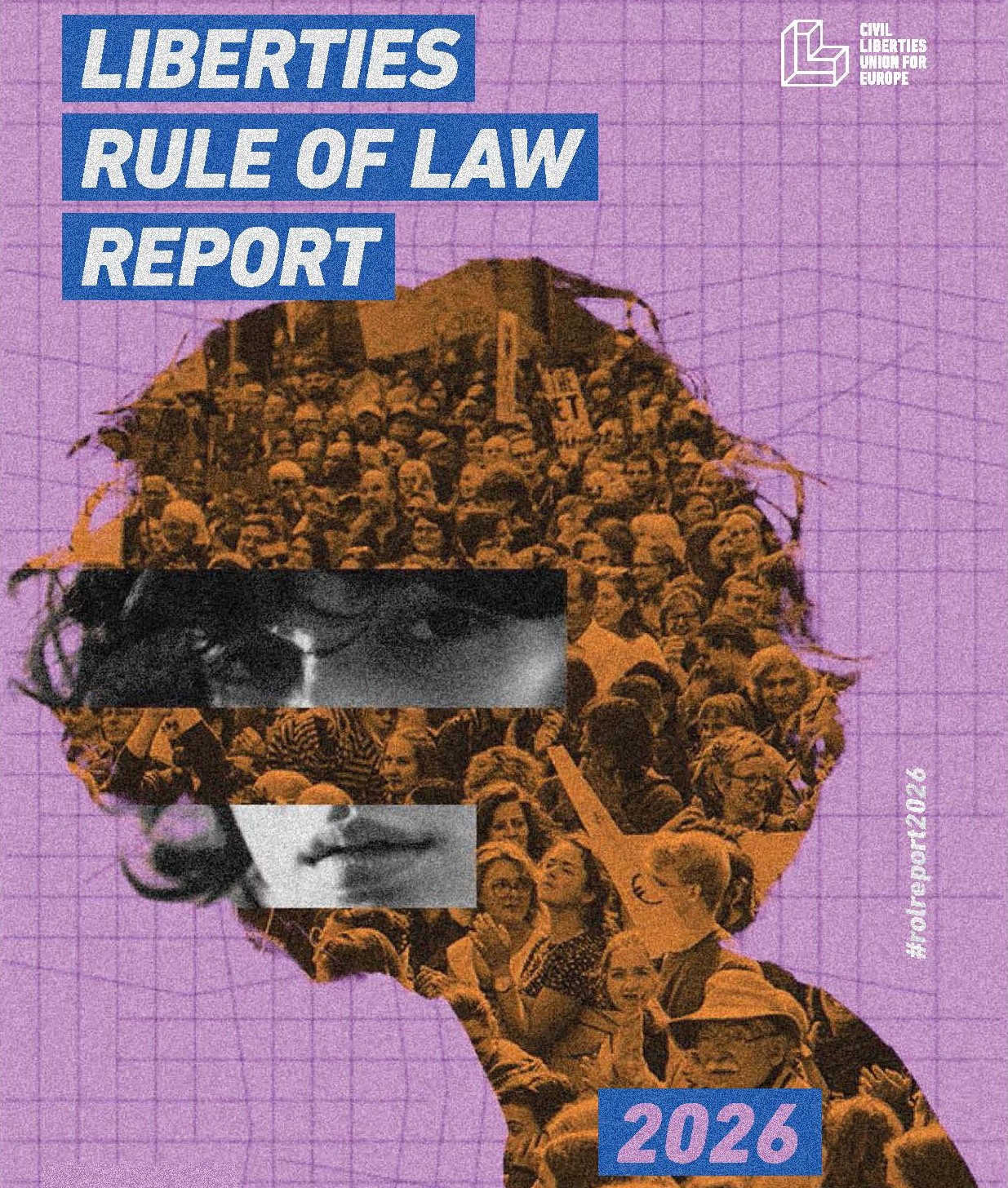
Liberties Rule of Law Report 2026 – Stagnation, Regression and Shrinking Space for Democracy
The new, seventh annual Rule of Law Report by Civil Liberties Union for Europe for 2026 confirms a worrying trend of further weakening of democratic standards in the European Union. The report, to which the Centre for Peace Studies contributed alongside nearly 40 organizations from 22 Member States, analyses the situation in four key areas: justice, anti-corruption, media freedom, and checks and balances.
The main conclusion of the report confirms trends from previous years – democracy in the EU continues to decline, while Member States largely ignore the recommendations of the European Commission. The analysis reveals a widening implementation gap: as many as 93% of the 2025 recommendations are repeats from previous years, with 61% showing no progress and 13% showing regression. Not a single recommendation has been fully implemented.
From the perspective of Croatia, the findings further confirm already recognized negative trends. Croatia has been classified among the so-called “Dismantlers” – a group of countries that actively undermine rule of law institutions, alongside Bulgaria, Hungary, Italy and Slovakia. This classification reflects deep and long-standing problems in the functioning of democratic institutions, as well as a lack of political will to address them.
The situation in key rule of law areas remains concerning. In the field of justice, two-thirds of recommendations show no progress, accompanied by growing political pressure and an increasing number of unimplemented judgments of the European Court of Human Rights.
In the area of anti-corruption, more than half of the recommendations remain unimplemented, while media freedom shows stagnation or regression in two-thirds of countries, with ongoing political pressure, attacks on journalists, and insufficient protection against SLAPP lawsuits.
The greatest decline has been recorded in the system of checks and balances, where the increasing use of non-transparent and fast-track legislative procedures weakens democratic oversight of the executive. These trends are clearly visible in Croatia, where the space for the work of independent institutions and civil society is further shrinking.
“For the European Commission’s Rule of Law Report to have a real impact and prevent further backsliding, the EU needs a stronger and more focused approach. This should include systematic reporting, clear recommendations with measurable benchmarks, and consistent steps to trigger legal or other action when countries fail to comply. Only then can the Rule of Law Report function as the preventive tool it was originally intended to be,” said Kersty McCourt, Senior Advocacy Advisor at Civil Liberties Union for Europe.
Regarding the state of the rule of law in Croatia, the Centre for Peace Studies, which contributed to the country report, identified numerous problems across all areas covered.
In Croatia, there is a worrying increase in the public use of the Ustaša salute “Za dom spremni” and symbols of the NDH, including in the presence of high-ranking public officials. Despite clear legal positions that the salute is unconstitutional, parts of judicial practice have issued acquittals, often based on problematic reasoning invoking non-binding or non-existent legal grounds. Such developments contribute to the relativization of historically and legally unacceptable symbols in the public space.
The fight against corruption is stagnating, with unresolved structural problems in judicial independence, the functioning of the State Attorney’s Office, and the implementation of reforms. A lack of transparency in lobbying and public procurement, as well as the absence of accountability in high-profile cases, further undermines public trust.
Media freedom remains under pressure: political influence, attacks on journalists, and the failure to implement key recommendations on SLAPP protection and transparency in state advertising discourage investigative journalism.
Independent institutions and civil society are facing systematic and deliberate marginalization, reduced funding, and limited influence.
The Rule of Law report by Civil Liberties Union for Europe (Liberties) is available here.
The Liberties network press release is available here.